

← All articles
Amenities November 2026 · 5 min read

Amenity Booking & Access Control: Why They Should Be One System

A reservation app that doesn’t actually control the gate is cosmetic. Why amenity overcrowding keeps happening even with booking software, and what it takes to actually enforce a reservation.

VC
Vivo Control Integrator Team
Access control, installed for a living
Amenity Booking & Access Control: Why They Should Be One System

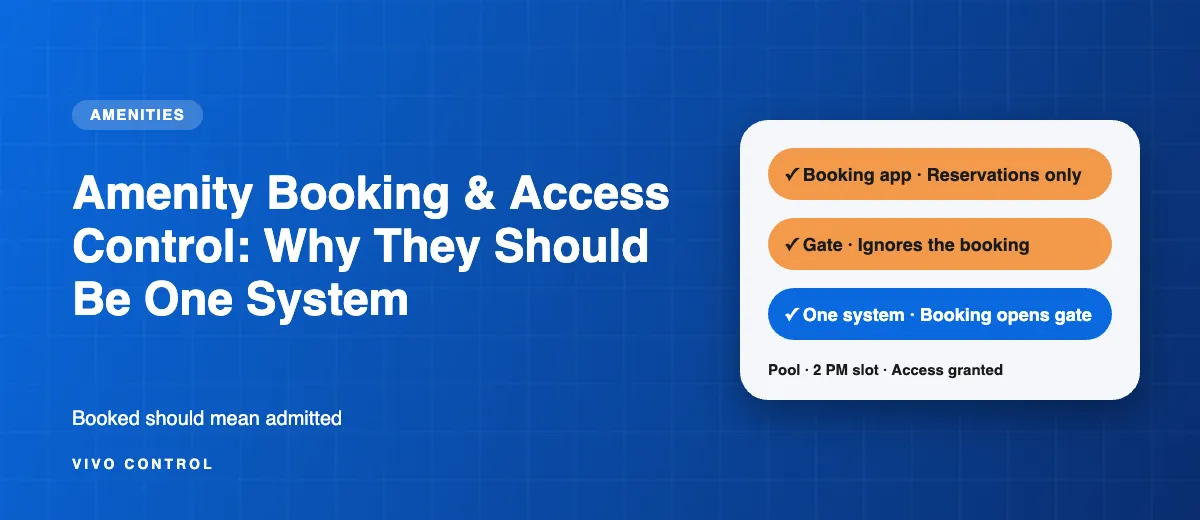
A board installs amenity booking software, residents start reserving pool time and clubhouse slots through an app, and the overcrowding complaints keep coming in anyway. The reason is almost always the same: the booking system and the gate are two separate systems that don’t actually talk to each other. A resident books a 2 PM pool slot, but the pool gate doesn’t know that — it opens for anyone with a key fob, reservation or not.

This post covers why amenity booking only works when it’s tied directly to physical access enforcement, not running alongside it as a separate app.

The gap between booking and enforcement

Most amenity management software does one job well: scheduling. It shows availability, takes reservations, prevents double-booking, and manages waitlists. What it often doesn’t do is control who can physically enter the amenity at any given moment — that’s handled by a separate access control system, usually a fob or keypad that works the same for everyone, all the time, regardless of what the booking calendar says.

The result is a reservation system that functions as a courtesy, not an enforcement mechanism. A resident who didn’t book still gets into the pool with their regular fob. A resident who booked but arrives 20 minutes late finds someone else already in the space, because nothing at the gate actually checked either reservation against who was walking through it.

Why this creates real operational problems

Overcrowding complaints persist even with booking software installed. If the fob or keypad at the pool gate grants the same access whether or not someone has a reservation, the booking system isn’t actually limiting who’s there — it’s just adding an extra step for the residents who bother to use it.
Occupancy caps aren’t enforceable in real time. A board can set a maximum of 15 people in the gym at once on paper, but without the access control system actually checking current occupancy against that cap at the door, the limit exists only in the policy document, not in practice.
Disputes have no real evidence behind them. When a resident complains that someone without a reservation was using the tennis court during their booked window, a board with separate booking and access systems has a calendar entry and no access log to confirm who actually entered and when — two half-answers instead of one clear one.
Fairness enforcement depends on residents self-policing. Reservation limits per week only work if something is actually preventing a resident from showing up outside their allotted slots. Without that enforcement at the door, a booking limit is a guideline, not a rule.

What actual integration looks like

The difference between amenity booking as a courtesy feature and amenity booking as a real operational tool comes down to one thing: whether the credential that opens the gate is the same system that manages the reservation.

Access follows the reservation. When a resident books a pool slot, access to that amenity is managed by the same platform that took the booking — not a separate step of “also remember to let people in.”
Access outside the reserved window is actually restricted, not just discouraged. A resident with a standing fob can’t walk into the gym during someone else’s reserved private training session if the fob and the reservation system are the same platform enforcing the same rule.
Every entry is logged in the same system, so if a dispute comes up, there's one clear record — who reserved the space and who actually entered, with timestamp and identity.
Capacity limits are enforced automatically, not just reflected in a booking calendar that assumes everyone follows it honestly.
Request a quote for your community.Get a quote

How this fits into Vivo Control’s platform

Amenity reservations and access control run on the same Vivo Control platform rather than as separate, bolted-together systems. Residents book the pool, gym, tennis court, or clubhouse from the app; capacity limits, fees, and deposits are enforced automatically; and every amenity entry is logged with timestamp and identity — giving boards a real record rather than two disconnected half-answers when a dispute comes up.

Frequently asked questions

This guide reflects general operational patterns in HOA and condo amenity management. Specific occupancy limits and amenity usage rules should be set according to your property’s governing documents and local safety codes.

Book a Vivo Control demo.

Tell us about your community and we’ll show you how it would work.

Book a demo