

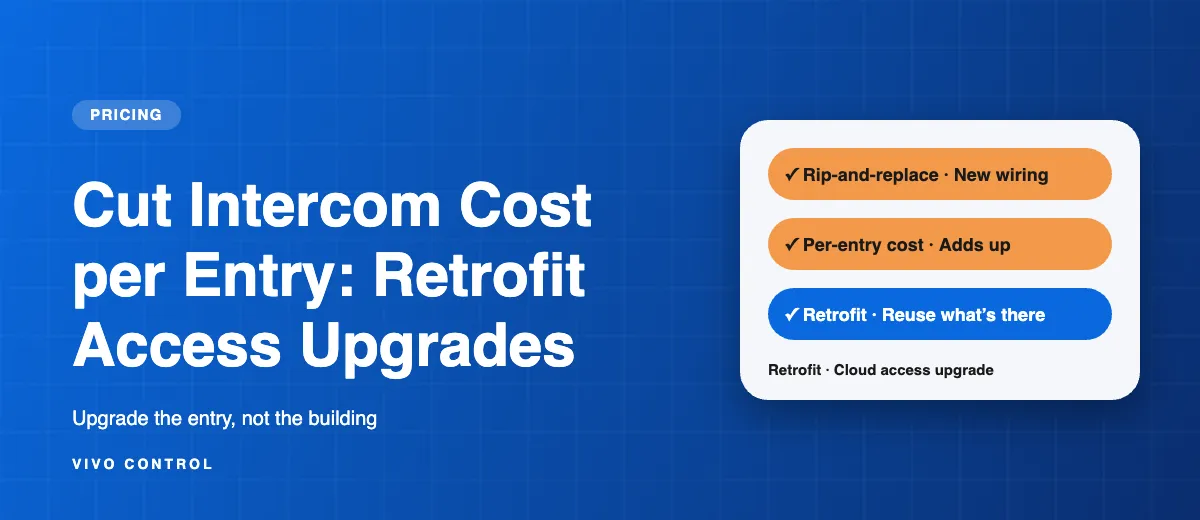
Managing real estate assets in high-density regions like South Florida, Puerto Rico, and Latin America requires a strict focus on protecting net operating income (NOI). When old access systems inevitably fail, property managers and multi-family landlords often face massive capital expenditure (CapEx) proposals. Traditional general contractor bids can easily convince boards that installing a truly secure low cost intercom system is impossible without tearing out hallway drywall or settling for weak, single-family residential hardware.
However, a fundamental technical shift in property operating infrastructure allows asset owners to significantly optimize their intercom cost per entry. By focusing exclusively on cloud-native software and adaptive physical hardware retrofits, commercial properties can deploy premium access security while drastically reducing structural installation constraints and ongoing equipment costs.
Properties reduce access costs by eliminating in-unit hardware, retrofitting existing functional door hardware, and deploying low-cost digital endpoints on secondary entrances. This unbundles hardware expenses from monthly software licensing.
When aiming to lower a building intercom cost, administrators must understand exactly how a security budget is structured. Traditional point-to-point analog wiring scales up physical costs linearly with every door and individual tenant unit added to the building.
Modern property operating platforms split this financial logic entirely: physical entrance equipment scales strictly by the number of exterior doors, while operational cloud software scales exclusively by the tenant density. This allows property managers to precisely map security hardware expenses based on actual structural traffic, completely avoiding the need to purchase dedicated monitors for every single apartment.
Abandoning Failing In-Wall Copper Wiring Without Cutting Drywall
By migrating to a cloud-native platform running on WebRTC, properties abandon damaged in-wall wires without cutting into hallways or apartments. Video and voice calls route directly to mobile apps or legacy cellular lines.
To avoid high commercial intercom system cost traps, ownership teams must stop attempting to repair broken, in-wall copper cabling. Decades-old infrastructure degrades rapidly in high-humidity markets like South Florida and Latin America. When property managers pay hourly rates to troubleshoot wire shorts inside a wall, they are throwing operational budget into a depreciating asset.
Modern video intercom systems bypass these failing wires entirely. The exterior entry panel utilizes an internet connection to process encrypted access requests and transmits high-definition WebRTC video straight to the cloud. From there, the system routes the visitor call directly to the residents' existing smartphones. This allows properties to completely abandon their dead internal wiring without cutting a single hole in the drywall or dispatching technicians inside individual tenant units.
Deploy Hybrid Entry: Video at Main Lobbies, QR Readers at Secondary Doors
High-traffic main doors receive full video stations, while low-traffic pedestrian gates and service entrances use QR access readers to verify visitors without expensive trenching, balancing the total deployment budget.
A common mistake that artificially inflates an intercom cost per entry is the assumption that every single perimeter point requires an interactive video touchscreen. Placing expensive video entry stations at secondary pool gates or isolated service corridors drives up hardware and network installation bills unnecessarily.
A smart hybrid approach installs premium video intercom systems at the primary lobby or the main driveway lane to handle active courier and guest communication. Meanwhile, secondary pedestrian gates, employee entrances, and delivery bays are secured using QR code access control readers. Visitors and delivery couriers simply scan digital QR keys on their smartphones to gain unassisted access. This eliminates the need for expensive network cabling, heavy trenching, and complex power runs at remote walls.
Protect your net operating income without compromising resident safety. Request a retrofit proposal to receive a value-engineered deployment plan, or book a platform demo to see how our unified cloud dashboard simplifies asset security.
Reusing Functional Door Strikes and Magnetic Locks to Slash Equipment Costs
Commercial access panels integrate directly with existing 12V/24V electric strikes and heavy magnetic locks, avoiding unnecessary physical lock replacements and minimizing structural door frame modifications.
Many security integrators recommend a "rip-and-replace" approach, suggesting the building must replace all entryway lock hardware during an intercom upgrade. However, if the current locksets are mechanically sound, this represents a massive waste of past capital investments.
Leading retrofit access control options are built to work with what you already have. These cloud hardware modules are specifically designed to connect directly with functional, pre-installed 12V/24V electric door strikes, magnetic locks, and third-party controllers such as SALTO or Axis. Retaining your functional lock hardware avoids the exorbitant costs of commercial locksmith labor and prevents destructive alterations to historical door frames.
Cloud Dashboard Eliminates Ongoing Technician Truck Rolls
Cloud dashboards allow off-site management teams to issue digital keys, revoke tenant permissions, and review visual entry logs dynamically, completely eliminating the need for recurring technician truck rolls.
Analog intercom systems typically hide their true costs in ongoing maintenance. Every time an administrator needs to change a tenant's name in the directory or revoke access for a lost key fob, they must dispatch an onsite technician to physically interact with the lobby panel.
Transitioning to a unified cloud framework removes this administrative overhead entirely. From a single secure web console, off-site management teams can handle property operations instantly. Staff can issue temporary mobile credentials, adjust specific gate schedules, and review video-linked access logs without ever paying for a localized service visit.
What to Prepare Before Requesting a Retrofit Quote
To secure an accurate architectural scope, document your entrance counts, categorize doors by visitor traffic levels, photograph existing lock hardware, and specify target deployment phases.
Before contacting a security vendor to evaluate your intercom system costs, landlords and condo boards must organize precise property details. Vague requirements inevitably result in bloated contingency fees. Prepare these four core structural elements to ensure a highly accurate bid:
Map out your total entryways. Clearly separate them into high-traffic main entrances (which require full video streaming) and low-traffic secondary doors or remote utility gates (which can utilize low-cost endpoints).
Determine your exact unit count using standard integration brackets (1–25, 26–75, 76–200, 201–500, or 500+) to select the appropriate software operating tier.
Note if your current frames use standard electric strikes, heavy maglocks, or older standalone mechanical hardware.
Identify which entrances need immediate modernization to solve critical liabilities, and which secondary zones can be updated in later phases to preserve working capital.
How the 24-Hour Scoping and Deployment Process Works
An integration engineer assesses your existing wiring viability, designs a value-engineered hardware mix, and initiates an expedited 24-hour property scoping window.
When you submit your intake metrics, a senior integrator reviews your property layout and existing wiring status within a few hours. The engineer maps out a tailored, value-engineered hardware mix designed specifically to reuse your functional infrastructure, and the platform delivers an expedited 24-hour property scoping window with your itemized hardware and software proposal. Once approved, certified installers are dispatched to the property, ensuring the system can be deployed and live in under 48 hours without compromising the integrity of the building.
Summary
Reducing capital expenditures does not mean property owners have to settle for flimsy residential hardware. By actively avoiding destructive drywall trenching, deploying hybrid entry systems, and embracing cloud-native mobile routing, properties across South Florida, Puerto Rico, and Latin America can build a reliable, budget-friendly security perimeter.
At Vivo Control, we engineer property-neutral access control platforms focused squarely on operational efficiency. Headquartered in Miami, FL, we equip multi-family operators, condo associations, and commercial facilities with scalable cloud tools that protect building assets and resident experiences. Built fully bilingual EN/ES by design, our platform ensures seamless directory communication across diverse tenant populations. Operating through a certified installer network, we ensure your structural deployment is executed efficiently while your access control is managed effortlessly over the cloud.
Modernize your property without sacrificing your reserve funds. Request a retrofit proposal today to initiate your 24-hour architectural assessment, or book a platform demo to see how our cloud dashboard empowers landlords to control their perimeter remotely.