

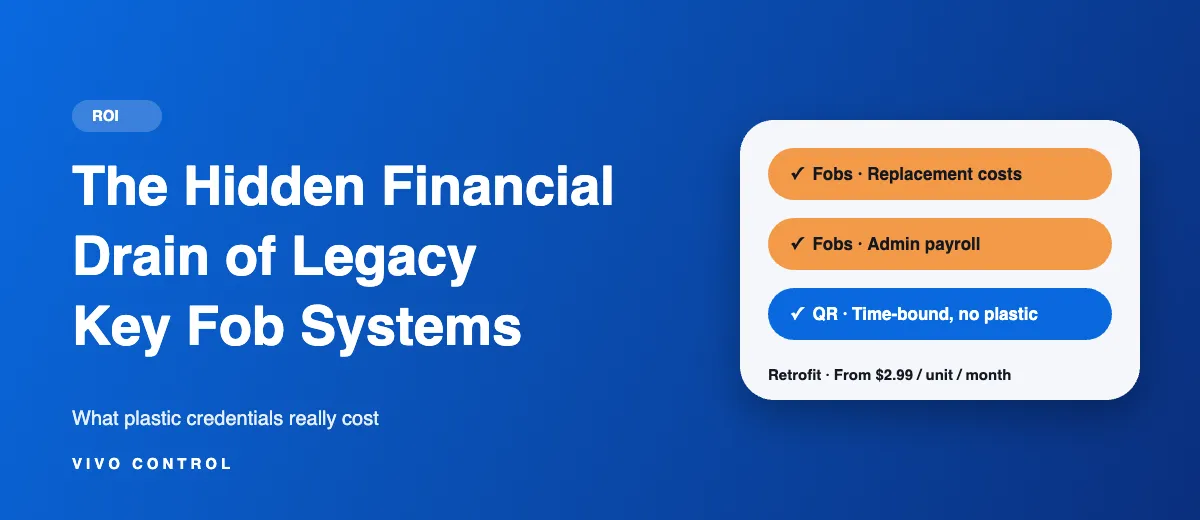
For HOA boards and condominium managers in Puerto Rico, South Florida, and across the Caribbean, managing building security frequently feels like an endless administrative chore. When properties rely on legacy proximity fobs or plastic keycards, the property manager's office effectively transforms into a low-level locksmith shop. Staff members waste hours every week issuing new fobs to new tenants, attempting to deactivate lost keys, and chasing down unreturned plastic from past occupants.
While the initial price of a single plastic fob seems trivial, the lifecycle cost of operating an entirely physical access credential system is staggering. Hidden behind the plastic is a massive, recurring financial drain caused by constant hardware replacement, manual administrative labor, and severe security liabilities. By calculating the true cost of legacy key fob systems, proactive HOA boards can justify the transition to a modern, digital alternative. Upgrading to an encrypted mobile access control system eliminates the recurring overhead of physical keys, securing the property while generating an immediate, compounding return on investment (ROI).
How Much Does a Key Fob System Cost to Maintain Annually?
Maintaining a key fob system requires budgeting for continuous key fob replacement costs, expensive localized server maintenance, and the administrative payroll spent constantly programming and deactivating lost credentials.
When an HOA board asks, "How much does a key fob system cost?" they usually focus on the initial installation of the electronic door readers. However, the true cost of a legacy fob system is hidden in its annual maintenance budget.
First, the community must constantly purchase boxes of blank proximity fobs to replace the ones that are inevitably lost, stolen, or broken by residents. Second, legacy fob systems rely on aging, on-premise localized servers. When that server requires a security patch or completely crashes, the board is hit with an emergency, unbudgeted IT repair bill. Most importantly, fobs are inherently insecure. They are easily cloned at local hardware stores or passed around to unverified visitors. When a fob is copied, the community loses complete control of its perimeter, exposing the HOA to massive security liabilities and potential lawsuits that far exceed the cost of the hardware itself.
The Hidden Administrative Cost of Physical Credentials
Property managers waste valuable operational hours tracking down and managing physical fobs, heavily inflating the true access control cost for HOAs and condominiums through wasted payroll.
The most expensive component of a key fob system is not the plastic key; it is the human labor required to manage it. In a high-density condominium, residents move in and out constantly. Managing this turnover with physical fobs is an administrative nightmare.
When a resident loses a fob, the property manager must drop their daily asset management tasks to log into a clunky, localized desktop computer, identify the specific fob ID, deactivate it, program a new physical fob, and physically hand it to the resident. If a tenant moves out and fails to return their fob, the manager must manually hunt through the system to revoke access. This continuous administrative friction forces highly paid property management professionals to operate as tech-support clerks, creating a massive, hidden payroll drain on the community's operating budget.
How Much Does an Access Control System Cost When Upgrading From Fobs?
Upgrading from a fob system requires budgeting for new edge hardware and a scalable software subscription, but these costs are heavily mitigated by using retrofit modules that attach to the building's existing wiring.
HOA boards are often hesitant to modernize their security because they fear the massive upfront capital expenditure associated with a complete hardware overhaul. Traditional security vendors frequently demand a total "rip-and-replace," requiring the property to discard functional electronic door strikes and tear out long runs of low-voltage wiring just to install new readers.
However, upgrading does not require destroying your current infrastructure. Modern cloud platforms dramatically lower the initial hardware budget. Vivo Control utilizes specialized retrofit access control modules that are completely open by design. Certified installers mount the new cloud-enabled panels directly onto the wiring you already have. By connecting seamlessly to your legacy electronic locks and gate motors, the property avoids expensive concrete trenching and full equipment replacements, shifting the budget into a predictable, scalable per-unit, per-month software subscription, with hardware quoted per access point.
Replacing Key Fobs With QR Code Access Control
Modern properties eliminate fob overhead entirely by deploying QR code access control, allowing residents to use their mobile devices as digital keys, with encrypted QR credentials linked to each resident's unit and verified identity.
To stop the financial bleed of physical keycards, properties must transition to 100% digital credentials. The Vivo Control platform replaces plastic proximity chips with QR code access control, turning the resident's smartphone into the ultimate digital key.
These digital credentials are fundamentally superior to plastic fobs because they are encrypted and time-bound. A resident simply scans their phone at the entry panel to unlock the door or gate. If a resident needs to grant access to a dog walker or a visiting relative, they issue a temporary, time-bound digital invitation directly from the mobile app. Because the credential expires automatically, the property manager never has to manually track it down or deactivate it. Furthermore, every single scan event is synced instantly with a central cloud dashboard, providing administrators with real-time access logs and a searchable, video-linked activity history.
Seamless Migration and Bilingual Resident Onboarding
Upgrading security infrastructure requires high resident adoption, which a platform built 100% bilingual EN/ES by design helps achieve by eliminating language barriers during the onboarding phase.
The most advanced video intercom and QR reader in the world is entirely useless if the residents refuse to use the corresponding mobile app. In diverse real estate markets like Puerto Rico and South Florida, deploying an English-only access application is a recipe for operational failure. A language barrier creates immediate frustration, forcing non-English speaking residents to flood the management office with technical support complaints.
For a frictionless migration away from fobs, the software must speak the language of the community natively. The Vivo Control ecosystem — including the front-gate panels, the management dashboard, and the resident smartphone app — is built 100% bilingual (EN/ES) by design. This native localization ensures that residents can easily navigate the app, issue guest passes, and review community announcements in their preferred language. Backed by bilingual support, the migration process is incredibly rapid. Residents scan a secure welcome QR code to activate their mobile credentials, achieving high adoption rates and allowing the community to permanently retire their legacy key fobs.
Book a demo to experience the bilingual mobile credential platform, or connect with our integration experts to get a quote and accurately price your community's retrofit upgrade.
What Should You Have Ready Before Requesting a Quote?
Before initiating a hardware upgrade evaluation, property boards must outline the exact unit density of the community, the total number of physical access points, and the status of their existing legacy hardware.
Because modern platforms quote the physical hardware (CapEx) separately from the recurring cloud software subscription (OpEx), submitting a vague architectural request is a major procurement error. Vendors cannot accurately forecast your transition budget without knowing the precise physical and operational layout of the building.
Ensure your property management team captures these exact data points before requesting a formal quote:
Clearly define whether the asset is a sprawling gated single-family HOA, a high-density condominium tower, or a mixed-use residential property.
Document the exact number of active residential units, as cloud software subscriptions scale directly by unit count rather than flat-rate licensing.
Quantify all structural entryways requiring active hardware integration, explicitly separating heavy vehicular gates from pedestrian lobby doors and shared amenity spaces (pools, gyms).
Audit the legacy door controllers, gate motors, and electronic strikes currently operating on the premises to determine if specialized retrofit modules can successfully reuse your existing wiring.
What Happens When You Request a Demo or a Quote?
A certified technical specialist will evaluate your property's footprint and legacy hardware to provide a customized pricing blueprint, ensuring you deploy the exact physical panels required to upgrade without forcing a complete rip-and-replace.
Transitioning away from physical key fobs to a secure cloud platform requires a highly detailed, professional scoping phase. When an HOA board or property manager submits their community details, the request enters an active evaluation window backed by a formal commitment to scope the property within 24 hours. Technical experts analyze the existing infrastructure to determine how to leverage open architecture, ensuring the new platform integrates seamlessly with your functional electronic doors and gates.
We highly encourage board members and management teams to book a demo during this 24-hour evaluation window. Experiencing the cloud dashboard firsthand allows stakeholders to verify the platform's bilingual capabilities and understand exactly how mobile credentials eliminate administrative labor. Once the custom budget is approved, execution is handled exclusively by a certified installer network — resulting in a streamlined setup completed in under 48 hours from kickoff to go-live — ensuring your community is fully secure and immediately freed from the financial burden of plastic key fobs.
Frequently Asked Questions (FAQ)
The annual cost includes continuous budgeting to purchase replacement key fobs, expensive call-out fees for localized server IT repairs, and the massive amount of administrative payroll wasted when property managers manually program and deactivate lost keys.
By utilizing an open-architecture platform, certified installers can deploy retrofit hardware modules. These modules attach modern cloud capabilities directly to your property's existing low-voltage wiring and legacy electronic locks, bypassing expensive rip-and-replace mandates.
Instead of a plastic chip, residents use their smartphones as secure digital keys. The system issues encrypted, time-bound QR codes that residents scan at the entry panel, completely eliminating the risk of lost fobs or cloned physical keys.
A system that is 100% bilingual (EN/ES) by design eliminates language barriers during the onboarding phase. This ensures that diverse resident populations can comfortably navigate the mobile app, driving rapid adoption and eliminating technical support friction for the property manager.
Yes. Legacy fobs can be easily cloned and shared with unverified visitors. Digital platforms utilize time-bound credentials that cannot be duplicated. Furthermore, every mobile scan is synced with a central cloud dashboard, providing the HOA with a searchable, video-linked activity history of every entry event.