
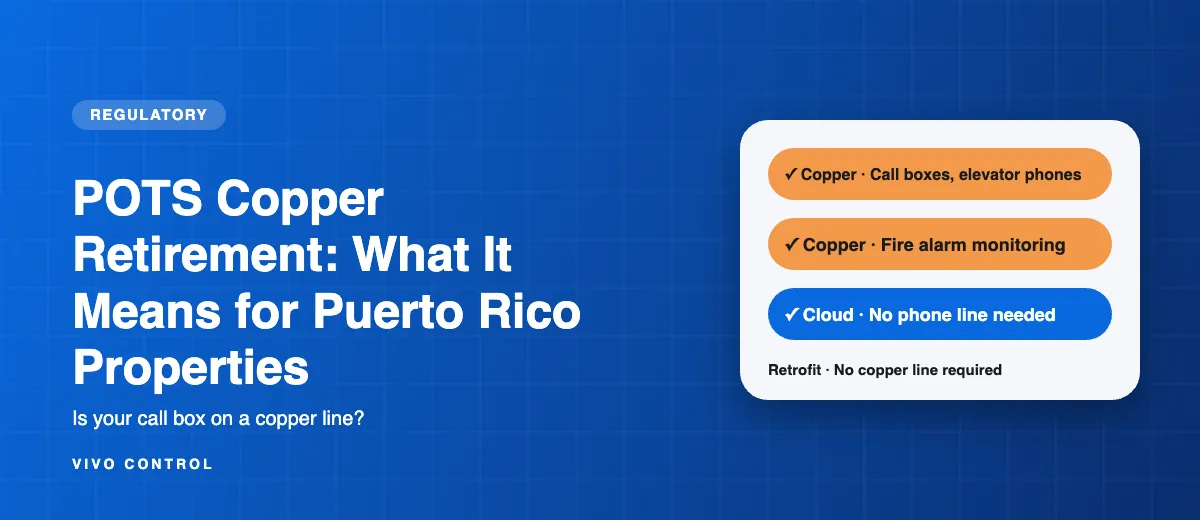
If your gated community, condo, or HOA still runs a call box, elevator phone, or fire alarm monitoring system on a traditional copper phone line, the countdown on that infrastructure has already started — and in Puerto Rico specifically, it’s not hypothetical. In March 2026, the FCC removed federal approval requirements for carriers retiring copper infrastructure, and the process got significantly faster.
This post covers what actually changed in March 2026, what it means specifically for properties in Puerto Rico, and what to check before a line goes dead with little warning.
What the FCC actually did in March 2026
In March 2026, the FCC removed federal approval requirements for carriers retiring copper POTS (Plain Old Telephone Service) infrastructure. Communities running call boxes on landlines are no longer protected by a regulatory buffer — carriers can give 90 days' notice and shut down the line.
The practical takeaway: don't assume a long runway before a specific line is affected. The only reliable way to know is to check directly with your carrier about the status of your property's address.
The FCC’s rules apply to the United States and its territories, which explicitly includes Puerto Rico. It does not apply to the Dominican Republic or Colombia, which have their own national telecom regulators. Carriers in those markets may be moving away from copper infrastructure for similar cost reasons, but not under the FCC’s rules — if your property is in DR or Colombia, the relevant authority to check with is your national carrier directly, not the FCC.
Why this matters more in Puerto Rico
In Puerto Rico specifically, POTS reliability after major weather events is poor: a copper-routed call box can be out for days or weeks following a hurricane.
If your property still depends on copper lines, ask your carrier whether your specific address is affected, rather than waiting to find out when a line stops working.
What’s actually at risk
Any system still running on an analog copper connection is exposed, not just residential phone lines. That includes:
None of these fail gracefully. When the copper line is retired, the system simply stops transmitting — there’s no dial tone warning, no gradual degradation. It’s there, and then it isn’t.
What to check now, not later
How this connects to access control specifically
Legacy call box and telephone entry systems — the kind that dial a resident’s phone number when a visitor presses a button — are exactly the category of system most likely to still be running on copper in older Puerto Rico properties. A system that depends on that connection for its core function is directly exposed to this timeline.
A cellular- or IP-based access control platform doesn’t carry this risk in the same way. Vivo Control’s panels connect via cellular or internet rather than copper telephone lines, and QR entry at secondary access points doesn’t depend on telephone infrastructure at all. For a property evaluating whether to replace an aging call box system, the POTS retirement timeline is a legitimate reason to move that evaluation up rather than treating it as a someday project.
Frequently asked questions
This post reflects publicly available information about the FCC's 2026 copper retirement changes. It is not legal or regulatory advice. Confirm your property's specific exposure directly with your telecom carrier.