

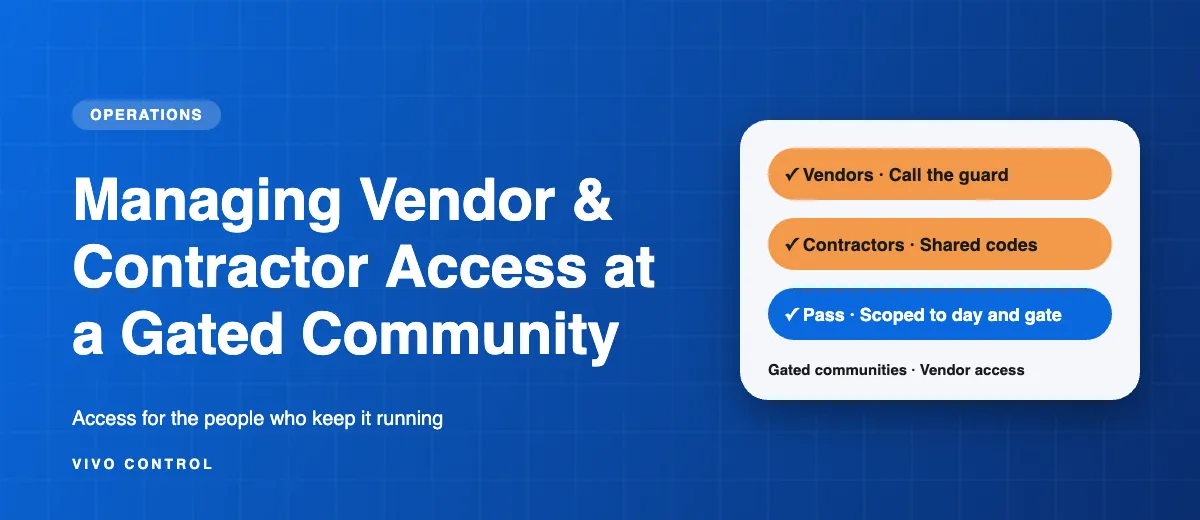
Vendor and contractor traffic is usually the highest-volume, least-managed category of entry at a gated community. Landscapers show up on a schedule. A plumber comes once, for one job. A pool company has a standing contract that runs for years. Every one of these relationships gets treated the same way at most properties: a shared gate code, handed out once, never revoked, and known by half the vendors who’ve ever worked there.
This post covers how to actually structure vendor and contractor access by the type of relationship, and why the access control decision is tied more closely to vendor risk management than most boards realize.
The three categories, and why they need different access
Treating all three categories the same way — usually by defaulting to a shared code or a standing fob — is what creates both the security gap and the audit trail gap boards eventually run into.
Why this connects to vendor risk management, not just the gate
Access control and vendor management are usually handled as two separate conversations at most HOAs — one is a board policy question (insurance certificates, contracts, licensing), the other is a hardware question (what’s at the gate). In practice, they’re the same workflow.
A contractor’s certificate of insurance, naming the HOA as an additional insured, should be confirmed before that contractor is approved for access — not checked separately from the access decision. If a contractor causes property damage and their insurance has lapsed, that’s the board’s liability exposure, and it’s directly connected to whether the gate should have let them in that day at all. Building the access approval step to require a current COI on file, rather than treating insurance verification and gate access as two unrelated checklists, closes a real gap.
The same logic applies to license verification for trades that require one. Capturing license numbers and expiration dates during vendor approval — not checking it manually at the gate, where staff shouldn’t be making judgment calls in real time — means the rule is enforced before access is ever granted, not negotiated by a guard under pressure with a line of cars behind the contractor’s truck.
What a workable system looks like in practice
How Vivo Control supports this
Vivo Control issues time-bound and recurring credentials by vendor, scoped to a specific schedule or work order rather than a shared code. Each credential’s access is logged individually, so an entry is always tied to who it was issued to, not just “vendor” generically. Recurring credentials can be set to match an ongoing contract’s actual service window and deactivated automatically when that window ends, removing the manual step boards most often forget.
Frequently asked questions
This guide reflects general best practices for vendor and contractor access management at gated communities and HOAs. It is not legal or insurance advice — confirm your property’s specific insurance and licensing requirements with your HOA’s attorney and insurance provider.