

QR entry or video intercom?The honest answer is: it depends on your building.
Both technologies work. Neither works for every property. This page helps you understand the difference — and why the best communities are choosing both.
This isn’t a competition. It’s a decision.
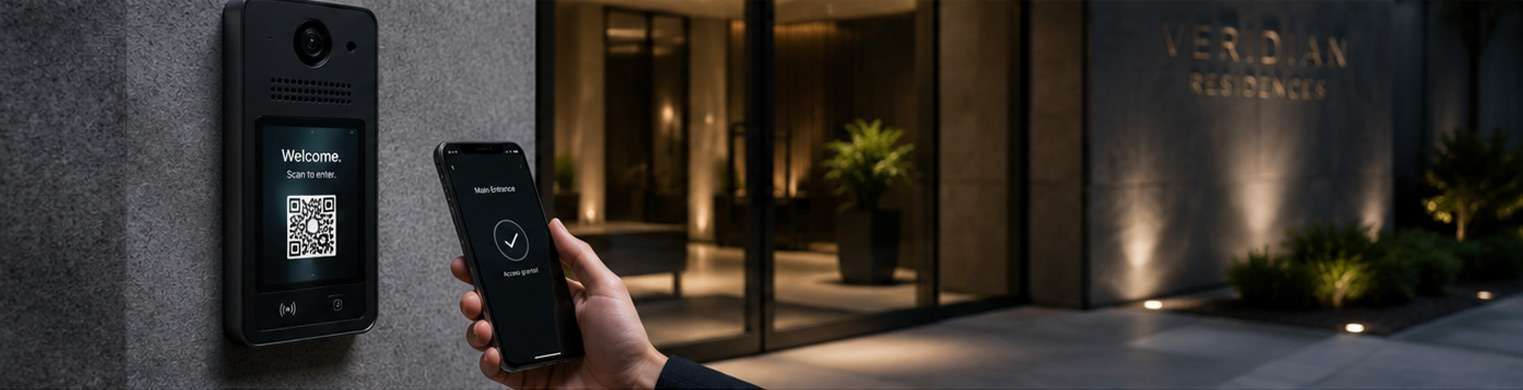
The access control industry loves to pit QR entry against video intercom like they’re rivals. They’re not. They solve different problems for different buildings — and the smartest properties aren’t choosing one. They’re using both.
What matters isn’t which technology is better. It’s which one — or which combination — fits your building’s entry flow, your residents’ expectations, and your operational reality.
Here’s the breakdown.
QR entry vs. video intercom. Side by side.
When QR entry is the right call.
QR entry wins in buildings where speed, volume, and operational simplicity matter more than live visual verification. That’s most properties.
High-volume gated communities
When 200 residents enter every morning, a video call at the gate creates a queue. QR entry moves people through in under 10 seconds — no wait, no friction, no missed calls.
Package and courier management
Couriers don’t need to talk to anyone. They receive a one-time code by text, scan in, deliver the package, and exit. Resident gets a notification. No one needs to be home. No one needs to answer a call.
Properties with absentee owners or investors
Residents who travel frequently or rent out units can’t always answer a video call. QR entry with pre-registered guest passes means the building runs without them.
Retrofit buildings with existing wiring
QR panels are compact, low-power, and compatible with most existing door and gate hardware. No demolition. No new conduit. Live in under 48 hours.
When video intercom earns its place.
Video intercom earns its cost in buildings where visual verification is a genuine need — not a habit carried over from 1990.
Luxury residential with concierge expectations
High-end residents want to see who’s at the door before opening it. Video intercom delivers that experience — and signals to residents that the building takes security seriously.
Buildings with vulnerable resident populations
Senior communities and buildings with at-risk residents benefit from the additional verification layer. Seeing a face matters.
Properties with no dedicated security staff
When there’s no guard and no front desk, video intercom gives residents a direct line of defense. They decide who enters — from anywhere, on their phone.
Main lobby as a trust signal
Even in QR-first buildings, a video intercom panel at the main lobby entrance signals premium quality to prospects and guests — and serves as a backup for visitors without a pre-registered pass.
You don’t have to choose. Most buildings shouldn’t.
The buildings that operate best combine QR speed at secondary entries with video verification at the main lobby.
Residents tap in at the parking gate in 8 seconds. Guests call from the lobby video panel. Couriers enter with a one-time code. Everyone gets exactly the experience the situation calls for.
That’s not a compromise. That’s what a community operating system looks like.
Questions we get asked about QR vs. video.
Yes. Vivo’s modular architecture lets you deploy QR entry now and add video intercom panels at any entry point later — without replacing hardware or reconfiguring the platform.
QR codes on Vivo are encrypted, time-bound, and single-use for guests. They cannot be screenshotted and reused. For resident access, mobile credentials are tied to a verified device — more secure than a keycard or fob that anyone can pick up and use.
The resident issues a new one from the app in seconds. The old pass is automatically invalidated.
Yes. Vivo’s video intercom calls the resident’s smartphone — they can see and speak to the visitor and open the gate from anywhere in the world. All they need is their phone and a data connection.
Hybrid. QR entry at gates and secondary access points, video intercom at the main lobby or visitor entrance. A senior integrator will recommend the right combination for your specific building during the free assessment.
Not sure which is right for your building?
Tell us about your property — entry points, resident profile, and current system. A senior integrator will recommend the right combination and send a clear quote within 72 hours.